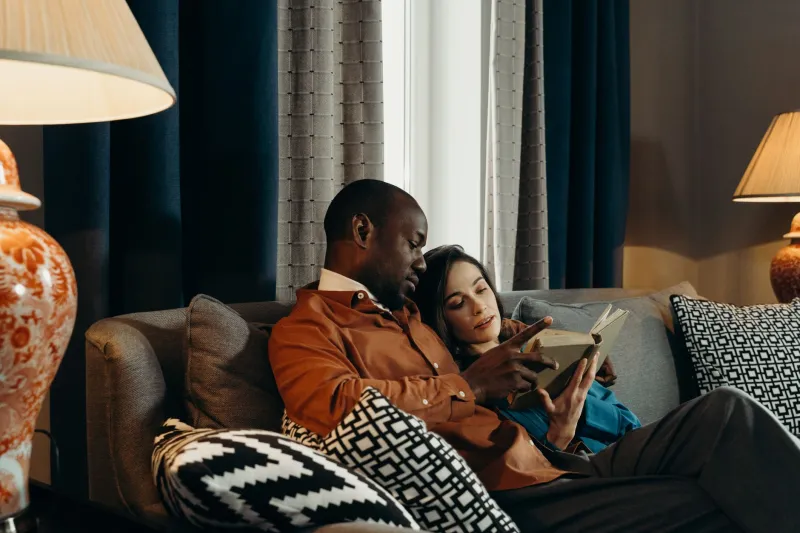
Couch, Blanket, Remote: The Holy Trinity of Doing Absolutely Nothing Wrong

Let's set the scene. It's Saturday morning. The coffee is hot, the throw blanket is achieving its full potential, and the streaming service is already asking — with suspicious enthusiasm — if you're still watching. You are. You absolutely are. And somewhere in the back of your brain, a tiny, deeply annoying voice pipes up: Shouldn't you be doing something?
Shoulda, woulda, coulda. That voice? It's lying to you.
The Great American Binge Guilt is real, it's widespread, and it is, frankly, exhausting. We've spent so long marinating in productivity culture — hustle harder, rise and grind, sleep when you're dead — that we've forgotten how to just... sit. Rest. Let a prestige drama wash over us like a warm bath. And that's a problem, not because TV is bad, but because the guilt we've attached to it absolutely is.
How We Got Here (Blame the Puritans, Honestly)
The American relationship with leisure has always been a little complicated. Historians love pointing out that the Puritan work ethic basically embedded itself into the cultural DNA of this country centuries ago, and we've been collectively twitchy about downtime ever since. Somewhere along the way, busyness became a status symbol. If you weren't exhausted, were you even trying?
Fast forward to the streaming era, and suddenly we have access to hundreds of hours of television at our fingertips — and an equally massive supply of think pieces telling us that watching too much of it is rotting our brains, ruining our attention spans, and making us bad people. The technology evolved. The guilt kept pace.
But here's the thing: leisure isn't laziness. And there's a meaningful, important difference between the two that somehow got lost in translation.
What Your Brain Is Actually Doing During a Binge
When you sink into a six-episode run of something genuinely good — the kind of show where the characters feel like people you know and the plot is tight enough to make you forget you have a body — your brain isn't shutting off. It's doing something pretty remarkable.
Narrative engagement activates multiple regions of the brain simultaneously. You're processing emotion, tracking character motivation, making predictions, feeling empathy. Psychologists who study the effects of storytelling on the human mind have found that getting absorbed in a fictional world can lower cortisol levels, reduce anxiety, and give your prefrontal cortex — the part that spends all week managing your to-do list and your existential dread — a genuine, well-earned break.
In other words, the show isn't a distraction from real life. It is real life, doing its job.
And rest — true, unstructured, nobody-needs-anything-from-you rest — is one of the most underrated health interventions available to Americans right now. Sleep researchers, therapists, and burnout specialists have spent years making this case, largely to a culture that nods politely and then sets a 5 a.m. alarm to go be productive.
The Permission Slip You Didn't Know You Needed
Consider this your official, notarized, Life of Riley-approved permission slip to spend a weekend on the couch without engineering a cover story about it.
You do not need to have "earned" it through a week of superhuman output. You do not need to offset it with a Sunday morning run. You do not need to tell anyone you "accidentally" watched eight episodes — there are no accidents here, only excellent decisions made by a person who knew exactly what they needed.
The mental health community has been quietly (and sometimes loudly) pushing back against the idea that rest requires justification. Therapists increasingly frame guilt-free leisure not as indulgence but as maintenance — the psychological equivalent of getting your oil changed before the engine seizes. You don't feel bad about maintaining your car. Stop feeling bad about maintaining yourself.
But What About the Guilt? (It's Persistent, We Know)
Here's a practical reframe for the next time that inner critic starts clearing its throat mid-episode.
Ask yourself: Would I feel this guilty about reading a book all weekend? Probably not, right? Books get a cultural pass that television somehow never quite earned, despite the fact that a well-written drama series involves the same emotional engagement, the same narrative investment, the same transportation into another world. The medium changed. The experience didn't.
Also worth noting: the people telling you to hustle through your weekends are often the same people who look genuinely bewildered when they burn out at forty-three. Rest isn't the enemy of productivity. It's the engine that makes it possible.
If it helps, rename the activity. You're not "binge-watching" — you're engaged in serial narrative immersion. You're not "doing nothing" — you're practicing intentional recovery. Ridiculous? Maybe. Effective? Remarkably so. Language shapes perception, and if rebranding your Saturday helps silence the guilt spiral, then grab yourself a snack and get immersed.
The Good Life Includes This, Actually
There's a reason this site is called Life of Riley. The phrase itself — living the life of Riley — conjures something specific: ease, enjoyment, the particular pleasure of a life that isn't constantly at war with itself. It's not about doing nothing forever. It's about recognizing that pleasure, rest, and entertainment are not the consolation prizes of a well-lived life. They are the life.
The weekend binge, done without apology, is a small but genuine act of self-determination in a culture that would very much like you to monetize every waking hour. Choosing to spend forty-eight hours in the company of fictional characters you love, wrapped in a blanket that has achieved its highest calling, is not a failure of ambition.
It is, in fact, a pretty solid life choice.
So queue up the next episode. Ignore the little notification asking if you're still watching — of course you are, it's a great show. And let the guilt dissolve somewhere around the cold open.
You've earned this. Actually, scratch that — you don't need to have earned it. You're a person who needs rest, and rest looks like this sometimes.
That's enough.