Cheese, Crackers, and the Quiet Revolution Happening on Your Coffee Table
Let's get one thing straight: the charcuterie board is not a trend. Trends come and go — remember cauliflower pizza? Low-rise jeans? The Snuggie? No, the charcuterie board is something far more dangerous. It is a philosophy. A carefully arranged, prosciutto-draped, cornichon-dotted philosophy that says, loudly and without apology: We are not eating lunch at our desks today.
And America, bless its overworked heart, is finally listening.
The Snack Heard 'Round the Country
For decades, the American relationship with food has been... complicated. We invented the drive-through. We perfected the sad desk sandwich. We created an entire category of product called "meal replacement bars," which is essentially just telling your stomach to clock in and stop complaining. Eating wasn't pleasure — it was maintenance. Fuel the machine, keep moving, optimize, hustle, grind.
But something cracked. Maybe it was the pandemic, which forced millions of people to actually sit in their own kitchens and remember that kitchens exist. Maybe it was the collective burnout of an entire generation that finally looked at their 11-minute lunch break and said, no thank you, I'd like some brie. Whatever the catalyst, food anthropologists are paying close attention.
"What we're witnessing is a genuine cultural recalibration," says Dr. Miriam Holt, a food anthropologist based in Austin, Texas, who has spent the better part of a decade studying American eating habits. "When people start investing time and intention into how they eat — not just what they eat — that signals a much bigger shift in values. Slow eating is a form of self-assertion."
Self-assertion. Through cheese. We love to see it.
The Board Is Mightier Than the Briefcase
There's a reason the charcuterie board became the unofficial mascot of post-hustle culture. Unlike a meal you inhale between Zoom calls, a spread demands participation. You have to arrange things. You have to consider whether the fig jam goes near the aged gouda or the smoked almonds. You have to slice the salami into little roses if you're feeling fancy, and nobody's going to stop you from feeling fancy.
It turns eating into an event — even if that event is just you, your couch, and a rerun of The Bear playing in the background with delicious irony.
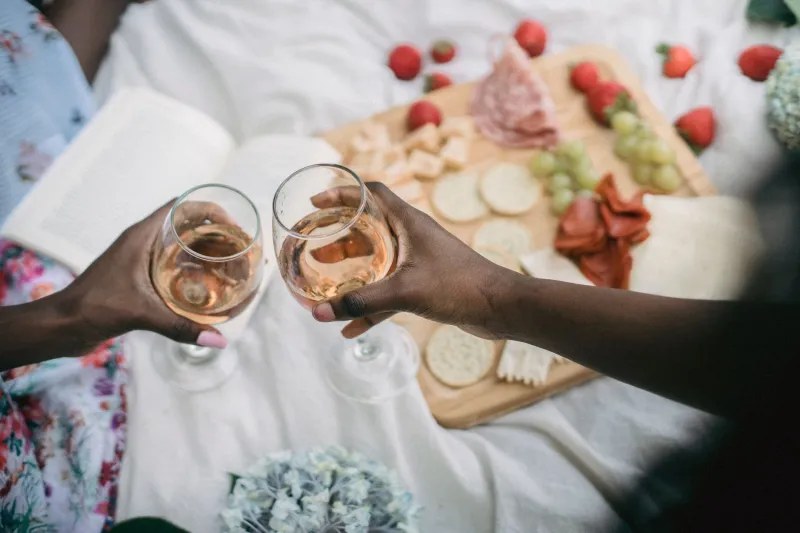
Tamara Collins, a 34-year-old graphic designer from Nashville, started hosting what she calls "board nights" with her friends two years ago. "We used to do dinner parties, but dinner parties have this pressure to them," she says. "Someone has to cook, someone has to clean, it's this whole production. With a board night, everyone brings something, you throw it all on a big wooden plank, and you just... graze. For like three hours. We talk. We laugh. Nobody's rushing anywhere."
Three hours. Of grazing. Of talking and laughing. If that isn't the Life of Riley, we don't know what is.
The Extended Lunch Break Makes Its Comeback
It's not just happening in living rooms, either. Across the country, a quiet rebellion is unfolding in the middle of the workday. Extended lunch breaks — once the exclusive domain of European professionals and retired gentlemen at country clubs — are making a stateside comeback.
Some companies, particularly in the wake of remote and hybrid work arrangements, have started offering what they're calling "real lunch" — an actual hour, sometimes ninety minutes, away from screens. Revolutionary stuff, truly.
Research backs up what your stomach has been trying to tell you for years: stepping away from work to eat an unhurried meal improves afternoon focus, reduces stress, and — here's the kicker — actually makes you more productive. So the irony is rich (much like a well-aged manchego): the act of not working through lunch turns out to be better for work. Hustle culture has been bamboozled by a cheese plate.
"We've medicalized rest," says Dr. Holt, "and we've medicalized eating. We talk about 'optimal nutrition windows' and 'mindful eating protocols.' But sometimes the most radical thing you can do is just sit down with people you like and eat something delicious without any agenda whatsoever."
No agenda. Just snacks. Write that on a motivational poster.
Gourmet Everything, Rushed Nothing
The gourmet snack movement — from artisanal jerky subscriptions to imported tinned fish becoming inexplicably cool (seriously, have you seen the tinned fish TikTok community? It's thriving) — points to something deeper than just elevated taste. Americans aren't just eating better snacks. They're spending more time on snacks. They're reading about them, sourcing them, photographing them, and yes, arranging them on boards with tiny little labels made on a label maker they bought specifically for this purpose.
This is leisure. Genuine, unapologetic, glorious leisure. Dressed up in the very acceptable costume of "food content."
Marcus Webb, a 41-year-old teacher from Portland, Oregon, discovered tinned fish during a particularly bleak Tuesday last winter and hasn't looked back. "I spent forty-five minutes last Saturday reading about different Spanish sardine brands," he admits, not even slightly embarrassed. "My wife came in and asked what I was doing and I said 'research.' She rolled her eyes but then she ate six sardines on crackers so who's winning, really."
Marcus. Marcus is winning.
The Permission Slip We Didn't Know We Needed
What the snacking revolution has given Americans, more than any particular food trend, is permission. Permission to stop. Permission to gather. Permission to spend forty-five minutes on a Tuesday doing absolutely nothing except deciding whether the honey pairs better with the blue cheese or the brie. (It's the blue cheese. Obviously.)
We have spent so long treating meals as obstacles between tasks — things to be optimized, minimized, consumed in transit — that we forgot they were ever supposed to be the point. Cultures around the world have always known this. The long Italian pranzo. The leisurely French déjeuner. The Spanish tradition of sobremesa, which is literally just sitting at the table after a meal and talking, because why would you leave?
America is arriving, fashionably late as always, to this particular party. And it is arriving with a stunning selection of cured meats.
So the next time someone makes you feel guilty for spending your lunch hour actually eating — for lingering over a good meal, for arranging your snacks with care, for treating the act of eating as something worth savoring — just smile serenely, pop an olive in your mouth, and remember: this is not laziness.
This is a revolution.
And it is delicious.